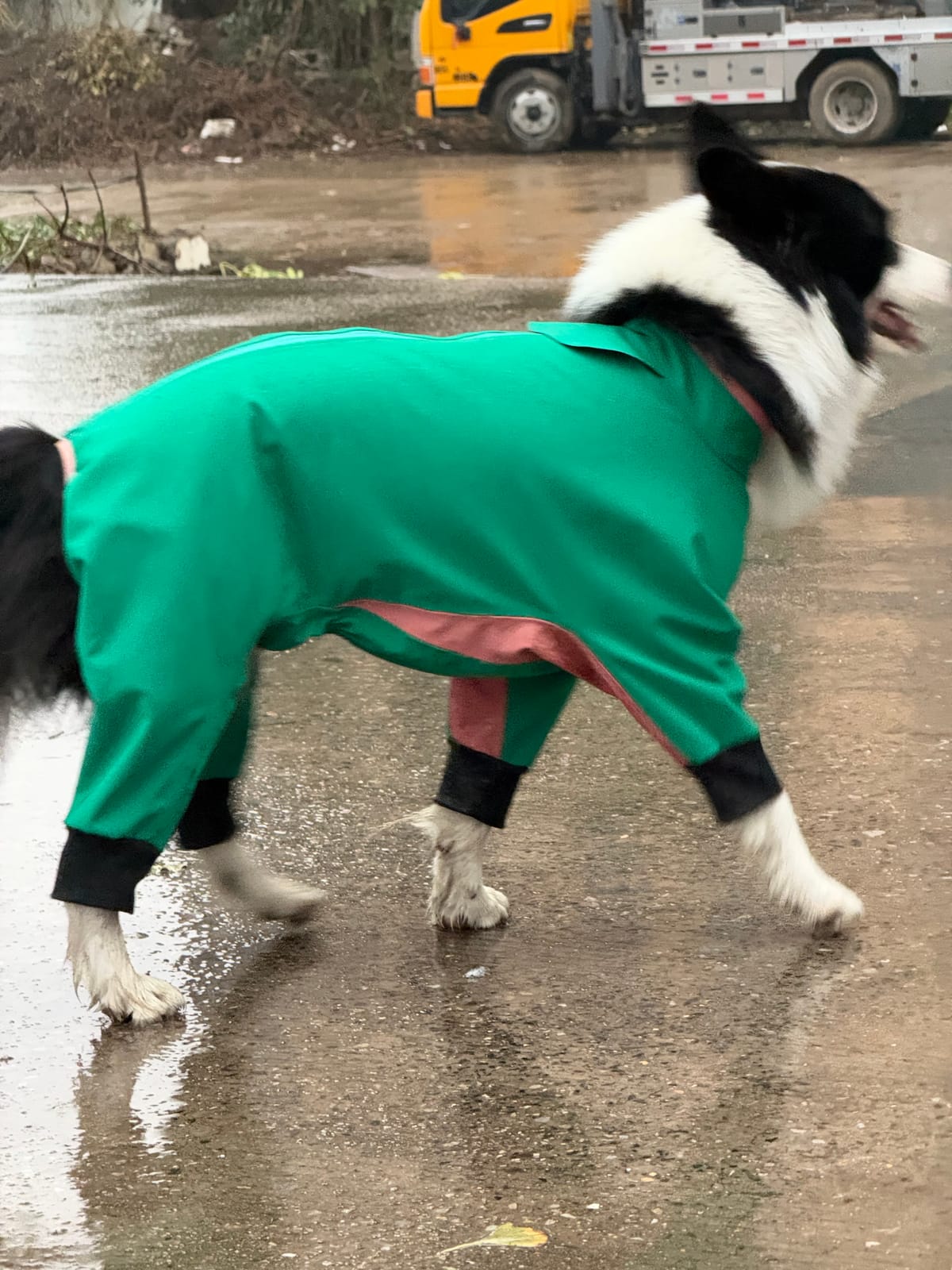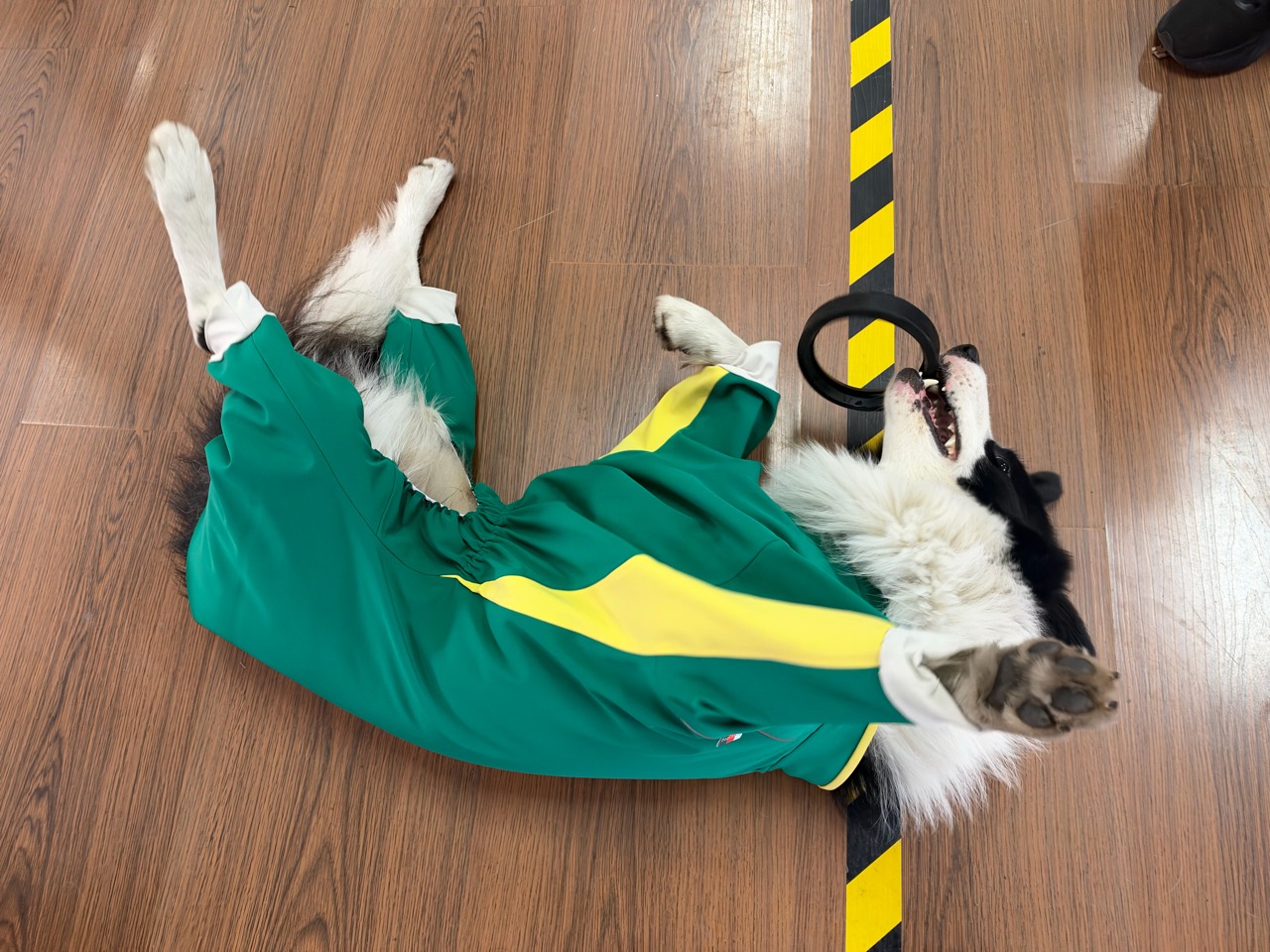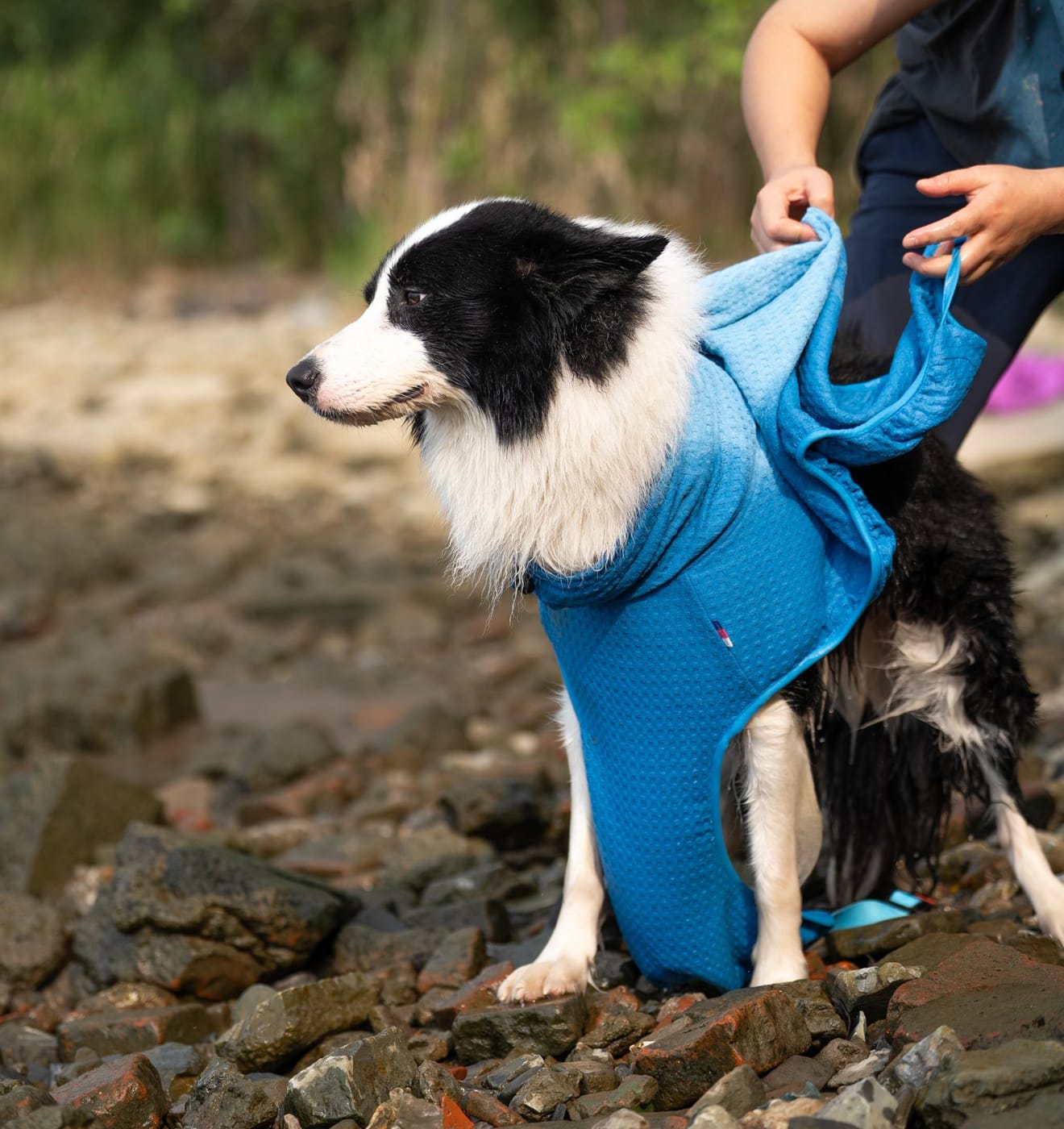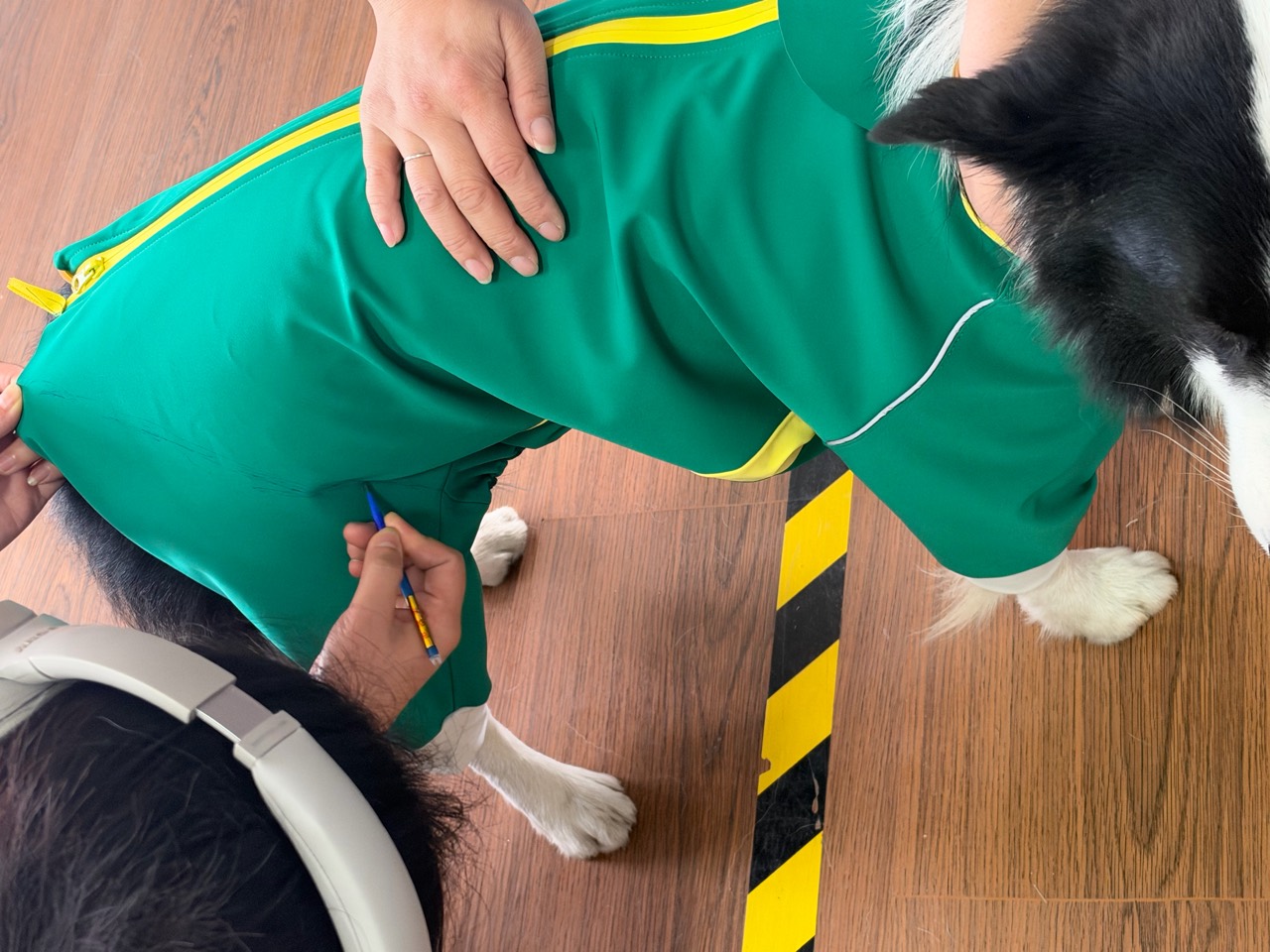
The border collie had a black rubber ring in its mouth when it rolled onto its back in our green raincoat sample. This position allowed us to see the elastic at the stomach and how well the sleeves fit over its bent legs. In a separate picture of the sample fitting process, one of the sample team members is holding the material taut and outlining on the green shell even though the dog is still wearing the sample. The line drawn by the sample team member will serve as a point of reference to the pattern maker for the next cut of fabric.
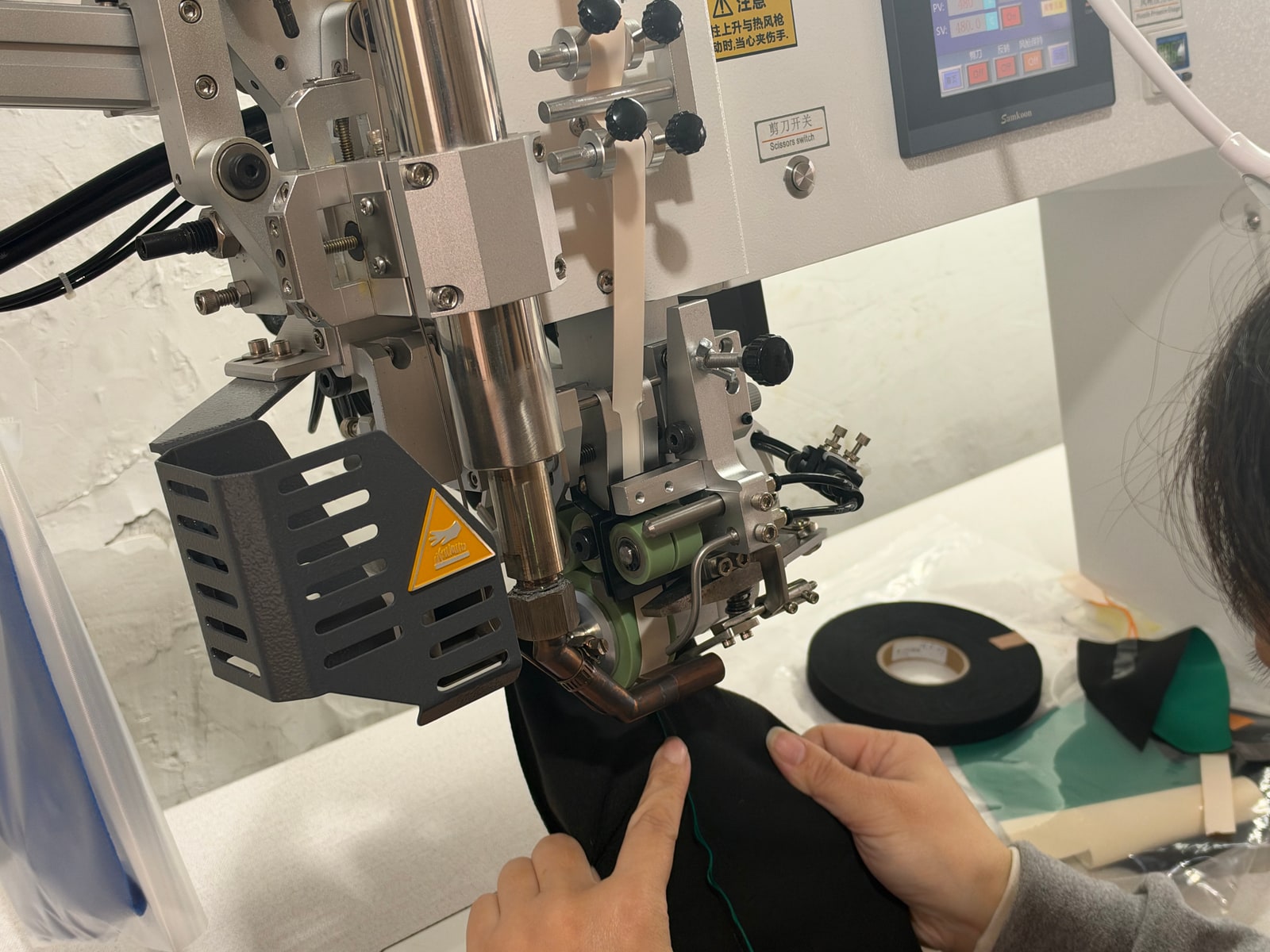
This sample design features a bright yellow zipper positioned at the back. When looking at the hot-air seam sealer, one can see the yellow zipper positioned beside the dark inner shell material as it goes into the rollers. These images portray an amazing view on how we craft personalized dog raincoats here at YR Exports. The shell, zipper, seam tape, and pattern all influence the fit of the suit as well as where moisture could penetrate.
Shell Fabrics and Seam Tape
When constructing a suit with four leg sections, the material used for the outer shell must be able to bend freely around the dog’s shoulder and hip areas with each motion made by the dog’s four legs as well as with each step that he takes. Two good candidates for a lightweight rainsuit are coated woven and supple laminated materials. Compare the weight of the two fabrics and how they will hang (drape), as well as their water resistance. In addition, you will want to see how the inner face (the side that will be in contact with the dog’s coat) of each fabric moves over the dog’s fur. Soft fabrics used to make shells can become stiff once they are put together and sealed. Therefore, testing a sewn section of leg in each fabric, prior to cutting out the entire shell, will help provide you with better insight as to how the final shell will feel once it is completed.
| Shell | When to try it | Flex and noise | Seam tape |
|---|---|---|---|
| Coated woven | Packable styles that need a light outer shell | Check stiffness and fabric noise on a sewn leg piece | Pair the tape adhesive with the actual coating (PU, TPU, etc.) |
| Supple laminate (2L or 3L) | Active four-leg cuts where soft drape matters | Bend the stitched joint to see how it flexes and sounds | Test a flexible tape suited to the backer, such as tricot-backed tape for a compatible 3L shell |
When picking a tape for trial seams, Bemis’s seam tape guide is a helpful reference because it groups options by shell backing. The adhesive has to match whatever surface sits on the inside of your fabric, whether that is a coating, a membrane, or a textile backer. Look for a tape wide enough to seal the needle holes and sit flat across both sides of the seam allowance, while still going around tight leg curves without creasing. Around the shoulder and hip joins where the dog bends with every stride, a softer, more flexible tape usually holds up better. Before cutting a full garment, we always run test strips on stitched scraps of the actual shell, let them cool completely, and then pull and bend the seam to see if any edge starts to lift.
Hot-Air Seam Sealing on a Four-Leg Raincoat
As Belsonic’s machine guide outlines, a hot-air sealer softens the tape adhesive right before the pressure rollers bond it to the fabric. In our sample-room clip below, you can watch the operator steer the stitched shell by hand so the curved seam stays centered under the roller as the fabric turns. Wherever two seams cross and several layers pile up, we stop to inspect both sides of the bump to make sure the tape did not bridge over a gap.
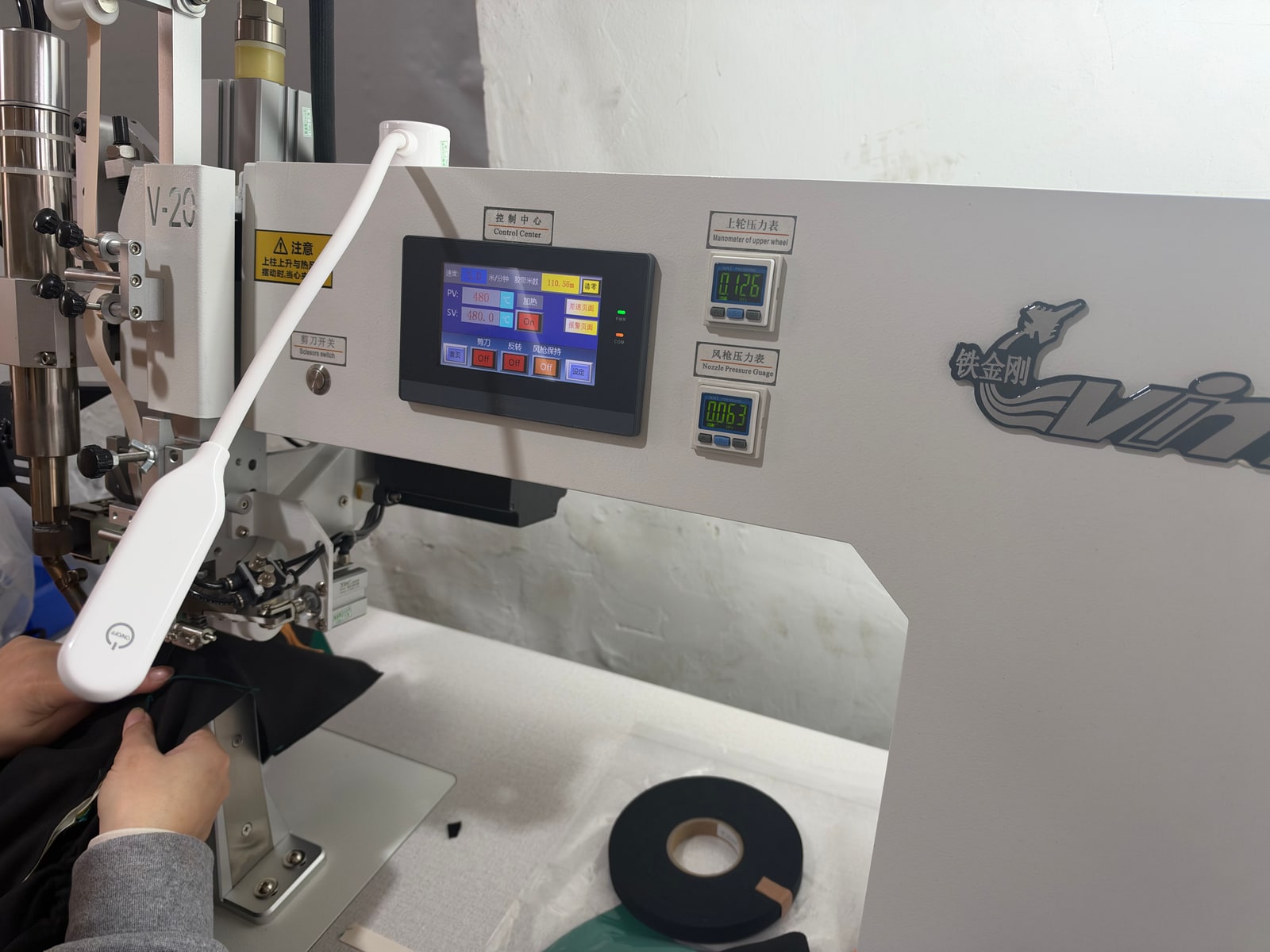
In the sample-room machine photo, the control panel is set to 480°C for the hot air and 5.0 m/min for the roller feed, with separate pressure gauges for the nozzle air and upper roller. Those were simply the numbers running during this sample. Actual heat transfer changes with airflow, nozzle angle, and dwell time, so every new fabric and tape pairing needs its own scrap trials to dial in temperature, speed, and roller pressure. Once the test strip cools down, check for puckered fabric, loose tape edges, or shiny heat marks before locking in the production settings.
Back Zippers and Harness Access
Having a long zipper down the back makes dressing much easier, since the owner can guide all four paws into the sleeves before zipping the suit shut. When sourcing a zipper for bulk production, we test how smoothly the slider runs, how naturally the tape curves along the dog’s spine, and whether the fabric stays flat beside the stitch line. Adding an inner placket under the teeth also helps keep long fur from catching in the slider. For a water-repellent closure, buyers often look at specs like YKK AquaGuard. On the finished coat, the two spots we check most closely are the top and bottom zipper stops and the needle lines running alongside the tape.
For dogs that wear a harness underneath, we can build a dedicated leash opening right above the D-ring. We always test that slot with a leash clipped in and pulled tight, because a storm flap that looks neat and flat on a cutting table can easily gap open once the dog pulls forward.
Four-Leg Fit Problems: Chest Pull and Cuff Drift
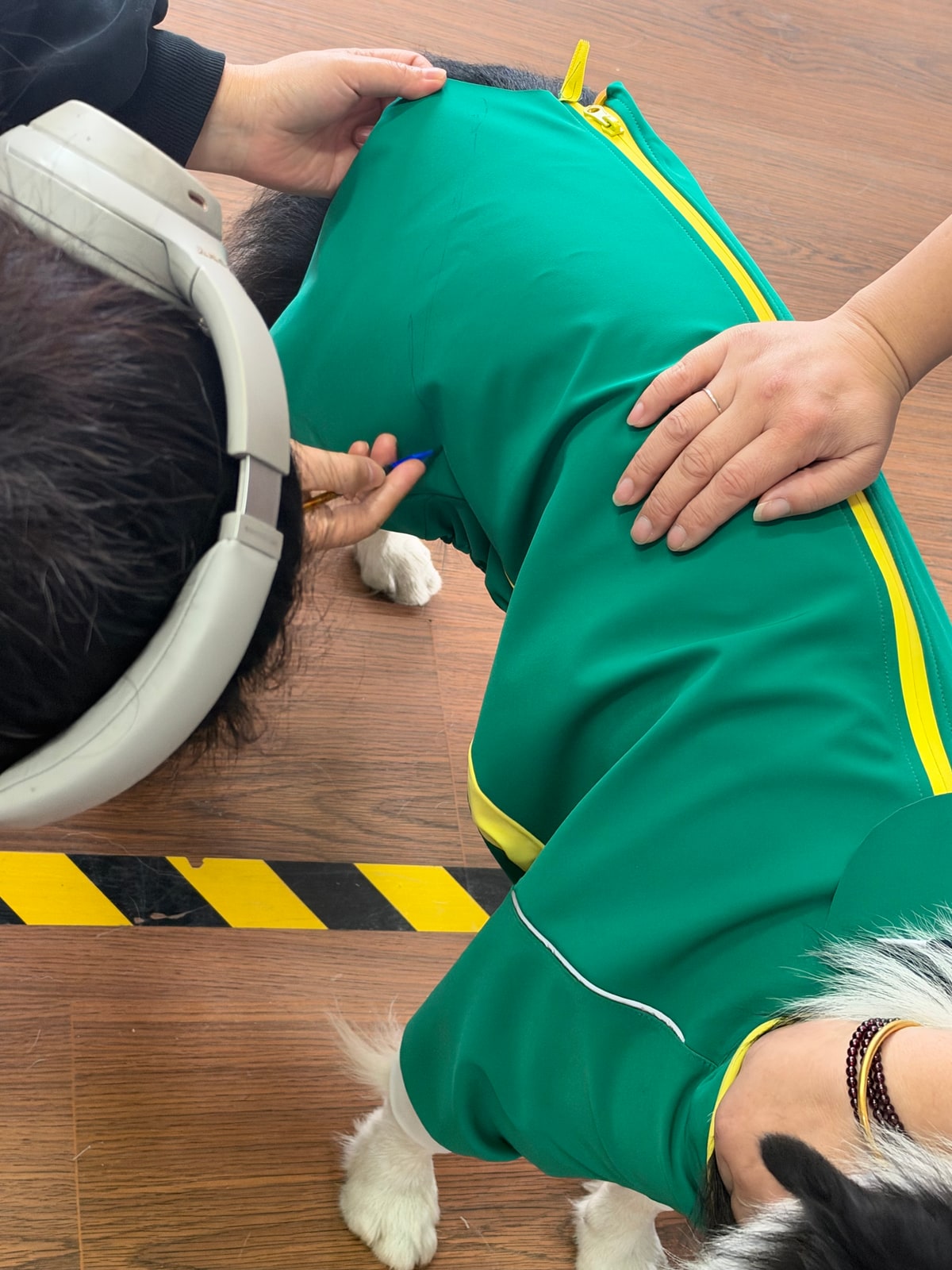
Back length and chest girth give us the starting size, while the live fitting shows where the pattern is actually binding. When the shell pulls tight across the chest as a front leg strides forward, the fix usually sits in the armhole curve and the angle where the sleeve meets the body. When a cuff keeps creeping down toward the paw as the leg bends, we adjust both the sleeve length and how snug the cuff opening is. Those pen marks drawn directly on the sample let the pattern maker redraw the paper pattern accurately, while keeping the panel edges aligned and leaving enough clean seam allowance for the sealing tape.
Before signing off on a fit sample, watch the dog walk, turn sharply, sit down, and bend its legs rather than judging the suit while the dog stands still. Keep an eye out for tightness under the front legs, cuffs sliding over the paws, or a belly cutout that shifts to one side. Opening up a little extra ease at the joints usually solves movement issues without giving up rain coverage.
Fabric Ratings and Finished-Suit Water Checks
For the shell material itself, state the waterproof rating you need in millimetres of water column and verify it with the ISO 811 fabric test. Because a waterproof fabric alone does not guarantee a dry suit, it also helps to agree on a finished-garment spray test focused on taped junctions, zipper ends, and harness openings, with the spray angle, test time, and pass standard written down before bulk cutting. Remember to check fit across your size curve too, since a taped seam that lies smooth on a flat bench can feel noticeably stiffer on a small sleeve bend.
On OEM pet apparel, our typical starting point is around 500 pieces per style, with 3–7 days for a first sample. If you already have a target water-column rating, size chart, or harness slot requirement, share those in your inquiry so we can source the right fabric and plan sample testing around your spec.
Working on a four-leg dog raincoat for your brand? Send over your tech pack or a reference sample along with your size range and expected weather conditions, and we will map out the first sample and testing checkpoints with you. Discuss your dog raincoat project with YR Exports
See examples of pet apparel we manufacture
Dog Raincoat OEM FAQ
What is the MOQ and sampling time for a custom four-leg dog raincoat?
Our typical MOQ for custom pet apparel is around 500 pieces per style, and a first sample usually takes 3–7 days. Final lead times depend on your pattern complexity, shell fabric, and trim availability.
Can you add a leash opening for a harness under the raincoat?
Yes, we can add a harness opening tailored to your layout. Send us the harness or its key measurements so we can line the slot up over the D-ring, and we usually add an overlapping flap to shed rain. During fitting, test it with a leash clipped in and pulled from different angles.
What waterproof tests can I specify for my dog raincoat?
Most brands specify a hydrostatic head target in mm of water column for the shell using the ISO 811 method, then pair it with a finished-suit spray check covering the taped seams, zipper stops, and harness slot. If you also need a seam-pressure test, confirm the test method and pass limit before sampling, since final performance depends on the chosen fabric and test results.
Colourway Samples on the Dog